There's a saying in the markets: price follows volume. Not the other way around.
Retail investors watch price. They see a stock gap up 33% and call it a surprise. They see MSFT holding green on a red day and call it luck. They watch DDOG launch through every moving average on earnings and wonder how anyone could have seen it coming.
FUP Analytics members weren't surprised. They saw it days earlier — in the volume.
What Volume Buzz Actually Measures
Volume Buzz isn't a simple volume spike alert. Raw volume spikes are noise. Earnings announcements, index rebalancing, options expiration — these all create volume that means nothing directionally.
What Volume Buzz tracks is institutional footprint activity — unusual volume measured against a 365-day baseline, filtered through price behaviour, trend structure, and stock quality score. When a high-quality, well-ranked stock begins trading at multiples of its average volume while price action remains controlled, that's not retail chasing. That's accumulation.
The critical distinction is accumulation vs distribution. Both look like elevated volume on the surface. Accumulation shows up with price holding or grinding higher — quiet, deliberate block buying. Distribution shows up with price fading into the volume — institutions unloading onto buyers. Volume Buzz is calibrated to surface the former.
The results this month speak for themselves.
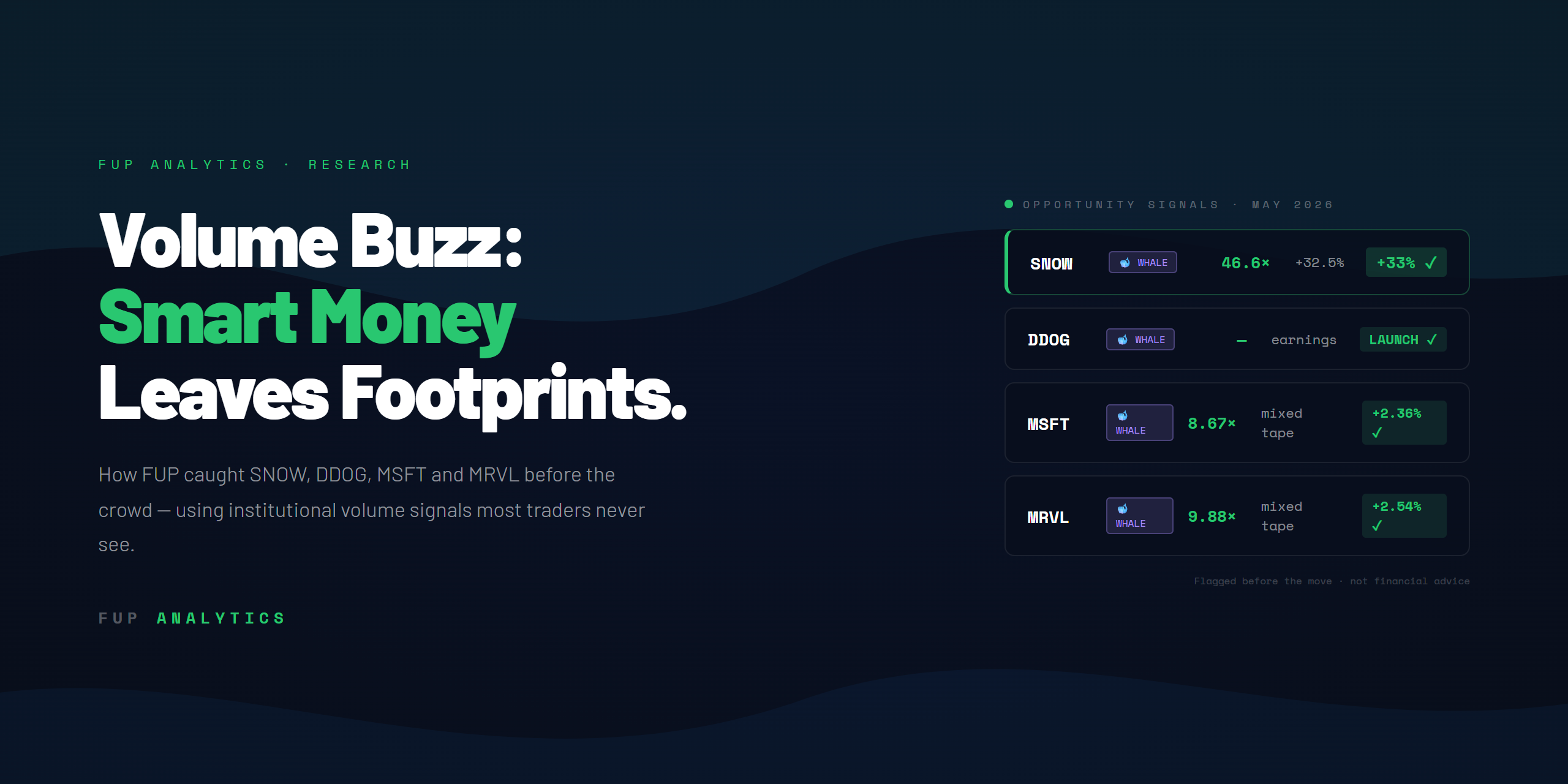
SNOW — 46.6× Average Volume. Then +33%.
THE SETUP
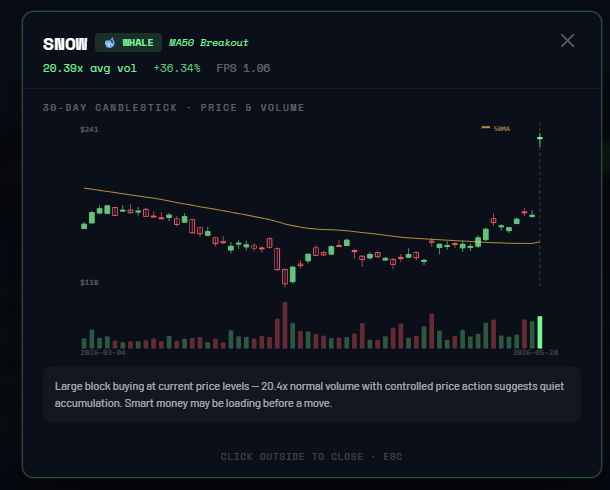
Snowflake sat at the top of the Volume Buzz list for multiple consecutive sessions before its earnings report. Not once — repeatedly. Day after day, 46.6× its average daily volume. MA50 Breakout classification. FPS score of 0.94.
A single day of unusual volume is an event. Multiple consecutive days is a thesis being built by someone who knows more than the headlines. Institutions don't buy all at once — they accumulate over sessions, quietly, in blocks designed not to tip their hand. SNOW's volume told that story clearly.
When SNOW reported earnings and gapped +33% at the open, the crowd called it a surprise. FUP members had been watching the accumulation play out in real time for days. The volume told the story. The earnings result confirmed it.
DDOG — All Moving Averages Compressed. Then Launch.
THE SETUP
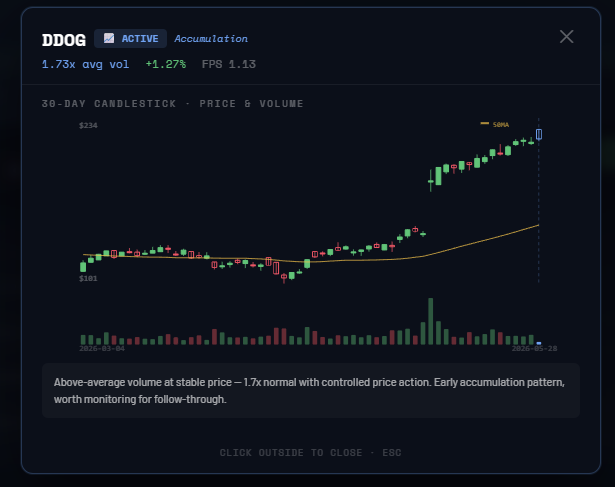
Datadog showed a different flavour of the same signal. Multiple moving averages compressed into a tight coil — energy building, volatility contracting, price going nowhere fast. Then on earnings: a massive volume candle that ripped price clean through every moving average in a single session.
What followed wasn't a fade. Price held the breakout. Every pullback was bought. The moving averages fanned out in all directions — the textbook signature of institutional repositioning, not a one-day reaction. FUP caught DDOG on the day it launched. The stock never looked back.
MSFT — Quiet Accumulation at the Bottom
THE SETUP
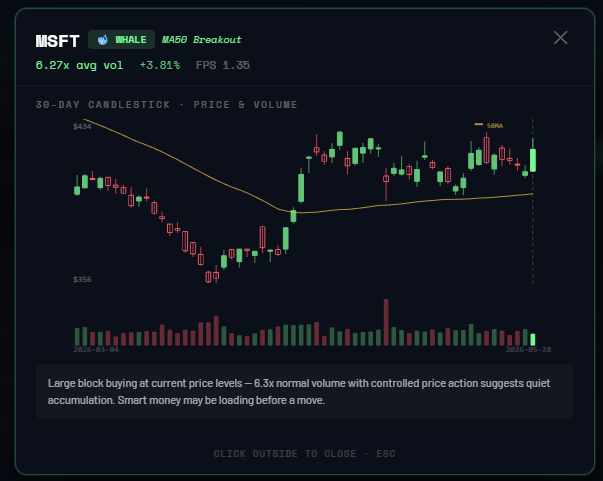
Microsoft told a slower, quieter story. After a significant flush to the low $350s, Volume Buzz flagged MSFT at 8.67× its 30-day average volume with controlled price action — no explosive candles, no dramatic moves. Just steady, patient block buying while the stock was still near its lows.
The chart caption said it plainly: "Large block buying at current price levels — 8.7× normal volume with controlled price action suggests quiet accumulation. Smart money may be loading before a move."
On a mixed market day where MU fell 1.85% and the broader tape showed no conviction, MSFT printed +2.36%. The institutions that loaded quietly during the accumulation phase had no interest in selling into weakness.
MRVL — Same Signal, Same Result
THE SETUP
Marvell Technology appeared alongside MSFT on the same Volume Buzz session. Same signal type — high FPS score, MA50 Breakout classification, whale-level volume ratio. On the same mixed market day, MRVL closed +2.54%.
Two different names. Same signal. Same result. Same day.
The Scoreboard
Four tickers. Four Volume Buzz signals. Four confirmed moves — one explosive earnings gap, one multi-week launch, two stocks outperforming on a choppy tape. This isn't coincidence. This is pattern recognition applied to the right data.
The institutions moving these stocks don't announce their positions. They accumulate over days, quietly, in blocks that show up in volume data before they ever show up in price. Volume Buzz exists to surface exactly that — the signal in the noise, before the crowd sees the move.
Price follows volume. It always has.